Category: Non-Violence

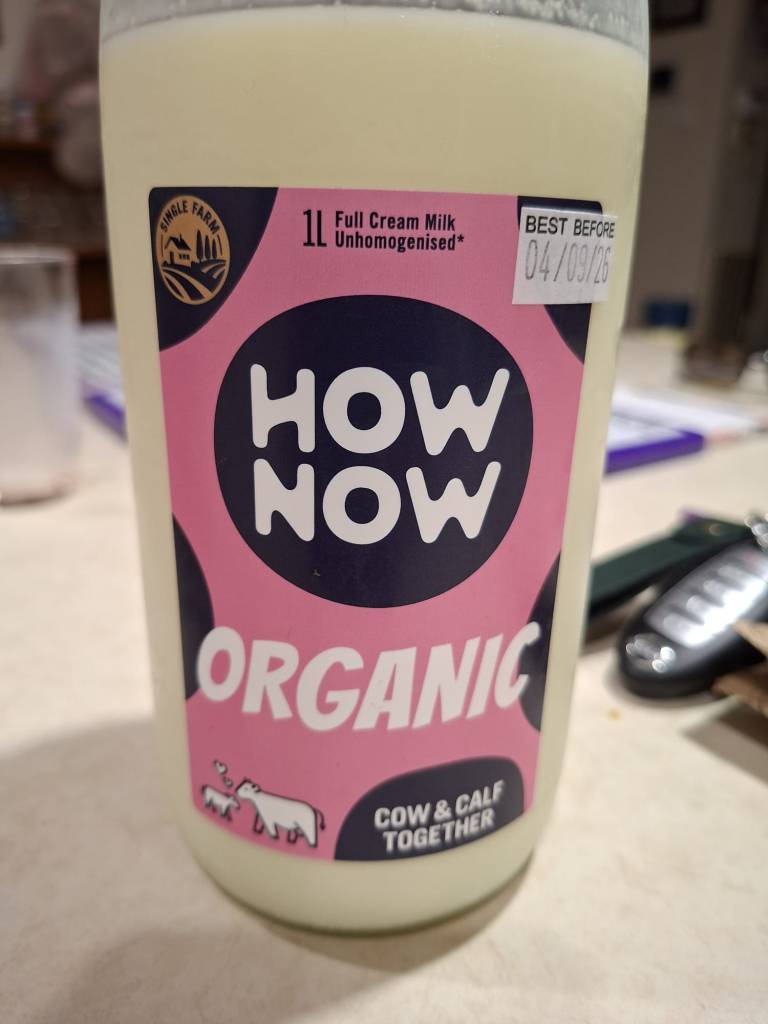
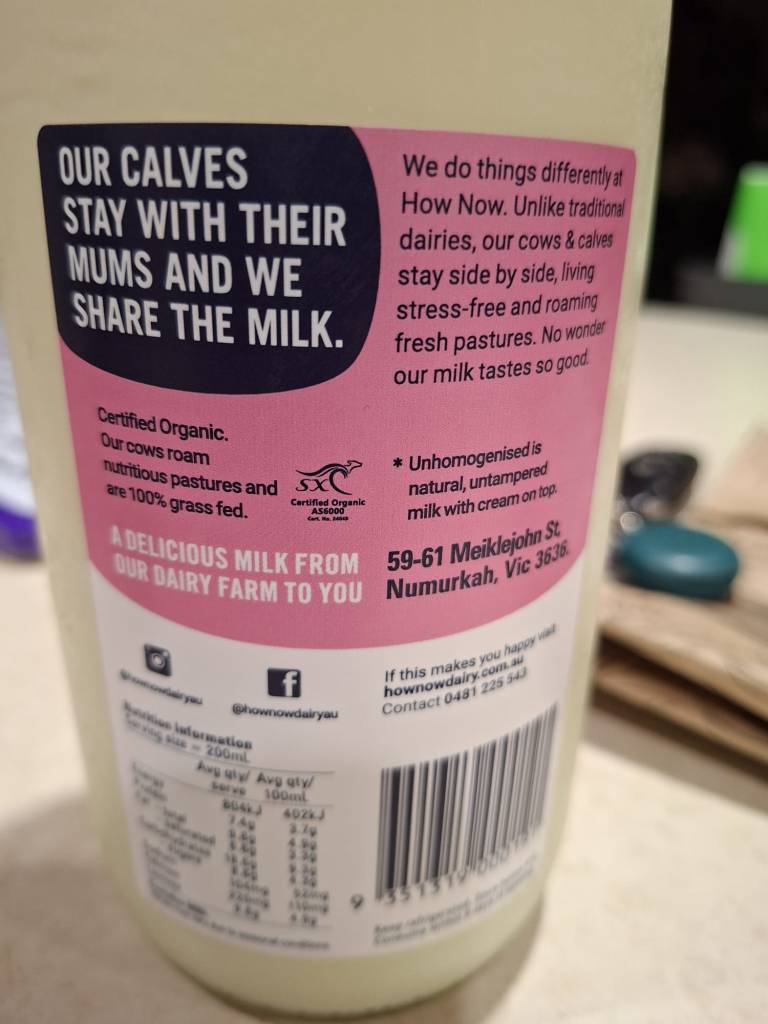
  • I finally got around to it. I drove 40 mins to Brunswick, picking up a friend on the way, and we bought How Now milk from Supa IGA on Sydney Road. I drove my friend home and then drove myself home. I reached for a glass pretty much the minute I stepped into the house and ended up drinking two glassfuls of this absolutely delicious milk. I can’t believe I have only just now discovered this milk. I don’t think I will buy another milk again as long as this one remains available. No slaughter, cows and calves stay together, the cows are treated kindly, and the taste is delicious. I am so grateful that this exists and that I found this.

    ,
  • I grew up learning about ahimsa as something that takes place in thought, word, and action (man, vachan, kaya). I have thought a lot about what being violent looks and feels like, and where my personal lines are in terms of what thoughts, words, and actions I allow in my life (including the less avoidable forms of violent thoughts, words, and actions). But recently I’ve been thinking about my “receiving preferences” as well – weird concept, I know – living in a world where existence is violence, and violence in even the most loving of relationships and interactions is, to varying degrees, unavoidable.

    It’s a complex concept and a pre-sleep word-vom cannot do justice to exploring it. But I am currently conceptualizing a simplistic quadrant – 1. good intention, good impact (non-violent in both thought and action); 2. bad intention, good impact (violent in thought but not action); 3. good intention, bad impact (non-violent in thought but violent in action); and 4. bad intention, bad impact (violent in thought as well as action). I know this only deals with thoughts (intention) and actions (impact), and I haven’t filed “words” under either intention or impact, because I think that is context-dependent.

    Obviously my first preference as the receiver of violence would be the best case scenario, which is good intention and good impact = no violence. But it’s harder to say whether I’d choose the second or third options as my second preference. I lean towards 2. I would rather not be actually harmed, than not be intended harm towards (that feels clumsily worded but I’m keeping it). This goes for both loving relationships as well as interactions with strangers. If someone hates me, that is their business. But if they can and do hurt me, that becomes my business. With strangers this is easier because there is nothing really to lose. But with loving relationships, I would say this comes with the assumption that the ill-intention or ill-will is momentary, and part of a passing emotional state or misunderstanding, rather than a pattern of wishing me harm. If it was a pattern of wishing me harm but not being able to hurt me, I would rather not be in relationship with this sort of person and would like them to wish me ill from the stranger category instead of the friend category. But if it’s a momentary anger or intrusive thought or mood shift? It would feel like violence on my part to not allow them to have it. I feel the world might be a safer place, and more non-violent overall, if we could all safely have our moments of imperfection in thought without the danger of harming anyone by acting on it.

    I say this as someone who does not routinely have ill will or negative thoughts about other people in general. I actually can’t relate to having any serious bad intentions towards other people, even of the fleeting variety, so maybe this is my naivety speaking. But yes I’d rather be safe around an ill-intentioned person than be harmed by a well-intentioned person.

    I’m reminded of the Hindi saying, “naadaan dost se dana dushman bhala hai”. It is better to have a wise enemy than a foolish friend.

    I’m also reminded of the TV show House, where Dr. House routinely appears to hold utter disregard for his patients as people, but treating their symptoms as a puzzle to be solved, and being uniquely skilled at his job is able to diagnose and treat patients more effectively than his more well-intentioned colleagues. I know that is fiction but I’d rather be treated effectively and professionally by a doctor who personally hates me than receive harmful treatment from someone who is nicer to me. In an ideal world of course it would be both, lol, they would be nice AND treat me the way I need. But if I had to choose, I would care less for what they are thinking in their head than what they are doing for me impact-wise.

    As I write this though, I do feel like there was a time when I would have chosen differently. A few years ago when I first started going to therapy, I think I remember feeling like it was of the utmost importance that my therapist like me and be genuine with me. Maybe that’s because the nature of therapy and therapeutic treatment is essentially distinct from a lot of other professions (thinking about Carl Rogers’ concept of unconditional positive regard, etc). Or maybe I just haven’t thought this through enough yet.

    I also don’t want to come across as unforgiving towards violence by honest mistake, where a well-meaning person accidentally causes damage of whatever sort because of not knowing or not realizing or whatever, and they genuinely regret it/learn from it/etc. There is no question in my mind that accidental violence is also inevitable and for me is wholly worthy of forgiveness and it is part of the safety of relationships to allow space for this, too.

    So I’m treating this as “where I’m currently at, in an ongoing process of exploration” rather than a final verdict on a well-argued case. It’s definitely a big topic.

    ,
  • Life begins non-consensually. One cannot consent to being born. Depending on where one is, one cannot even always consent in the matter of giving birth. Once one is born, one cannot not need all the things one needs in order to survive and grow. In order for survival and growth needs to be met, one cannot request resources from one’s caregivers in a way that one would be equally ok with a yes or no answer.

    Children are relentlessly needy, and their caregivers are tasked with meeting their many needs mostly without the luxury of having a choice in the matter, and often (at least in the case of the conscientious types of caregivers), at a great sacrificial cost to the caregiver’s own routines, preferences, and often even well-being. The potential positives of such a relationship do not negate the cost: at best, the positives make the cost feel worth it.

    For many years, at least in the case of human children, the relationship between child and caregiver is practically defined by a severely limited ability to consent (for both parties, although the power imbalance between parent and child would make it arguably less consensual for the child). By the time all the child’s survival and developmental needs are met, and the child is ready to become an equal and consensual participant in the relationship, the impact of the long history of non-consensual interactions has solidified into patterns that often lead to an ongoing sense of non-consent.

    This is in the most natural of relationships – the one without which there is no existence. But the rest of existence also is continuously non-consensual, even if not to the same degree or with every participant in one’s life.

    My survival from moment to moment depends on the air that I breathe, the food that I eat, the water that I drink, the home/shelter I take refuge in, the relationships I maintain, all of which come at a cost to others whether it is animals or plants or microorganisms or human people. The cat currently asleep in my lap for my emotional and physical comfort does not have a say in being my cat, and cannot consent to the life I choose for her. The spiders that I capture and gently release outside the house (because I struggle to coexist with spiders and am more powerful than them) probably die anyway from being cold and disoriented, or from being eaten by a bird.

    And as for the plants that serve as my main source of food as a vegetarian, as well as a major aesthetic interest for me (I have both a backyard garden and an indoor plant collection), I don’t know how anyone knows for sure that plants don’t have their own system of experiencing pain or suffering. Every time I take a cutting to propagate a plant, or prune a plant for health and appearance, or otherwise interfere with its natural growth for my own pleasure, I wonder whether I am causing immeasurable pain and I offer the plant my heartfelt apology, in a language the plant probably can’t understand, and it is meaningless anyway because my actions are what they are and the plant has no way of changing my mind.

    All of these examples are the most well-meaning and most inevitable of the kinds of violence I have in mind. Then there is the actual problematic kind of violence that I really should be doing more about, but I find myself balancing my values with my convenience. The electronics I use, the clothes I wear, the plastic products my life is strewn with, the milk I drink, the many forms of privilege I have that give me an edge over other equally deserving people with fewer opportunities: all of these benefit me at the cost of others, whether humans or animals or plants or the oceans or the earth.

    And then there are the more abstract but still significant forms of violence. Who I vote for, which large corporations I give my business to, and which causes I speak up for vs stay silent about, where I donate my extra money vs where I don’t, and all the other ways in which I play my small teeny tiny individual drop in the ocean role in facilitating, or being powerless against, the violence of others.

    I could write so much on this topic. But as usual, it is getting late and I must set things down and return to it another time. Hinsa/violence may be the way of nature and the way of the world, and I am not exempt from participating fully in all of it, but I also take comfort in little mouthfuls of ahimsa as often as I am able to access them.
    ,